Open Enrollment FAQ
Below are answers to commonly asked Benefits Open Enrollment questions. These FAQs are intended to provide general information on current benefit offering and upcoming benefit offering changes.
What's Changing in 2027?
What are the key changes for 2027?
- The Aetna HMO (Standard) and Aetna Whole Health (AWH) HMO will no longer be available.
- An additional Aetna plan, the Aetna EPO 2000 Deductible Plan, will be offered.
- The current Aetna HDHP/PPO plan design is not changing, but its name in Workday will change from “Aetna OAMC PPO High Deductible (HD)” to “Aetna Choice PPO HDHP.” It will also have a new, but substantially similar, provider network.
- The current Aetna EPO plan is not changing, but will have a new, but substantially similar, provider network.
- The Aetna HDHP/PPO deductible for individuals within a family will increase to $3,500 in order to comply with IRS regulations.
- HSA contribution limits will increase to $4,500 for individual coverage and $9,000 for family coverage (no change to additional $1,000 catch-up for those 55 and older).
- The 2027 Healthcare FSA contribution limit has not yet been announced by the IRS, but is projected to increase.
Are the rates changing?
The 2027 rates for the Aetna EPO medical plan, Kaiser HMO, and Guardian dental plan have increased compared to 2026. The Aetna PPO/HDHP plan rates either decreased or had a slight increase, depending on the tier. Voluntary life insurance rates are age-based so while there are no rate changes, you will see an increase if you moved into a new age grouping.
Why will the Aetna HMO plans no longer be offered?
The University is moving to self-insuring (also called self-funding) its non-Kaiser medical plans, which affects how claims are paid. The HMO plans could not be self-insured and will therefore not be available beginning in January. As you are likely aware, healthcare costs nationwide have increased for several years, and while we hope to see that trend change in the future, there is no indication that it will. The move to self-insuring these plans allowed the University to substantially lower the increase for this year, and while we can’t guarantee that costs won’t rise significantly in the future, self-insuring gives the University more options to respond if they do.
I’m enrolled in the Aetna HMO (Standard) plan that will no longer be offered. What do I need to know, and what do I need to do?
- Because the Aetna EPO plan is the most similar in cost, coverage, and provider network to the Aetna HMO plan, you will be automatically enrolled in the EPO plan unless you take action during Open Enrollment to choose a different plan or waive medical insurance.
- Carefully review the EPO’s plan design (such as co-pay amounts) and rates.
- Check that your preferred healthcare providers are in-network with the EPO. For instructions on how to do so, refer to the response to the question How do I find out if my doctor (or other healthcare provider) is in-network with Aetna?
- Compare the EPO to other available medical plans in order to make an informed decision regarding your coverage in 2027. The plan summaries for each plan are available on our Open Enrollment site, along with a comparison chart.
- You will receive a new ID card for 2027.
I’m enrolled in the Aetna Whole Health (AWH) plan that will no longer be offered. What do I need to know, and what do I need to do?
- Because there will not be a University-sponsored medical plan that is similar in both coverage and per-paycheck cost to the AWH plan, you will not be automatically enrolled in a different medical plan. If you do not take action to elect a new plan, you will not have coverage through a Santa Clara University medical plan as of January 1, 2027. The Benefits Department will reach out to AWH enrollees prior to the end of Open Enrollment if they have not made a plan selection.
- Review and compare the available medical plans in order to make an informed decision regarding your coverage in 2027. The plan summaries for each plan are available on our Open Enrollment site, along with a comparison chart.
- The plans that have the most similar plan design (such as co-pay amounts) to the AWH plan design are the Aetna EPO and the Kaiser HMO, but the per-paycheck cost is higher under these plans compared to the AWH.
- The plan that has the most similar per-paycheck cost to the AWH is the Aetna EPO 2000 Deductible Plan (DP), but the plan design is different.
- While the per-paycheck cost is lower than the other medical plans, it is possible to end up paying substantially more out of pocket, depending on what services are needed during the year. It is important to understand how a deductible plan works. Certain services such as hospital services and surgery are subject to a $2000 individual/$4000 family deductible. Members are responsible for paying the full cost of these services until the deductible is met, and then a 10% coinsurance amount after. Please carefully review the plan summary for more information about covered services and whether they are subject to the deductible/coinsurance or co-pays.
I’m currently enrolled in the Aetna EPO plan. What do I need to know, and what do I need to do?
No action is needed if you wish to keep this same plan. However, because the provider network will be different, you are encouraged to to check whether your preferred providers remain in-network. The new network name is Aetna Select℠ (Open Access). You will receive a new ID card.
I’m enrolled in the Aetna OAMC PPO High Deductible (HD) plan. What do I need to know, and what do I need to do?
No action is needed if you wish to keep this same plan. However, because the provider network will be different, you are encouraged to check whether your preferred providers remain in-network. The new network name is Aetna Choice® POS II (Open Access). Note that this plan is being renamed in Workday to “Aetna Choice PPO HDHP.” You will receive a new ID card.
Workday Enrollment FAQs
How do I review my current (2026) benefit enrollments in Workday?
There are a few different ways to navigate to your elections; here’s one: Type “Benefit Elections” in the Workday search bar, then select the “Benefit Elections” report.
If I don't wish to change my benefit elections, do I have to take any action in Workday?
If you take no action, your 2026 elections will automatically roll over to 2027, with the following exceptions:
- If you’re currently enrolled in the Aetna HMO, which will no longer be available, you will automatically be enrolled in the Aetna EPO.
- If you’re currently enrolled in the Aetna Whole Health (AWH) HMO, which will no longer be available, as of January 1 you will no longer be covered by a University-sponsored medical plan, and you will not receive the $75/paycheck waiver credit. Please take action to either select a different medical plan, or enroll in the Waiver Credit benefit if you have access to other medical insurance.
- Flexible Spending Account enrollments (Healthcare, Dependent Care, or Limited Purpose) do not roll over; as always, FSAs require a new election each calendar year.
- Health Savings Account (HSA) elections will roll over unless you are turning age 55 in 2027. If so, you will need to enroll in the Health Equity HSA Catch-Up plan in Workday. You do not need to actually elect the $1,000 catch-up amount, this is simply the name of the plan in Workday.
Even if you don’t plan on making changes, we encourage all benefit-eligible employees to review their elections. This will be your opportunity to ensure elections are correct, that you’re covering the family members intended, and that you understand how much your benefit cost will be in 2027. It’s also a good time to make sure the beneficiaries you’ve named for your basic and/or voluntary life insurance are current.
When and how can I make changes to my benefit enrollments?
Benefit-eligible employees can make changes in Workday from Wednesday, November 4 through Friday, November 20. Look for the “Open Enrollment Change” task in the “Awaiting Action” section of the Workday landing page (or find it through the “My Tasks” envelope icon). Choose “Let’s Get Started” and follow the prompts to enroll or make changes. When satisfied with your elections, make sure to choose “Review and Sign” and then “Submit” by end of day November 20. More information can be found on the Open Enrollment site under “Guide: Navigate Open Enrollment for Desktop.”
I’m trying to submit my enrollment but it’s giving me an error; what’s wrong?
Click on the error link in the red bar for guidance. Most likely, you need to scroll to the bottom of the page and check the “I accept” box. If issues persist, please email [email protected] for assistance.
I submitted my enrollment then realized I need to make another change. Can I still do so?
You can make changes through November 20. To do so, choose the “Benefits & Pay” app. Under “Needs Attention,” there is an option to edit your Open Enrollment event. After you’re done making changes, don’t forget to submit them!
Dependent Enrollment FAQs
What if I need to add dependents?
Before you can enroll eligible dependents in any of your plans, they have to be added as dependents in Workday. If you haven’t already added them, make sure to complete the applicable eligibility affidavit(s): child/children, spouse, or registered domestic partner:
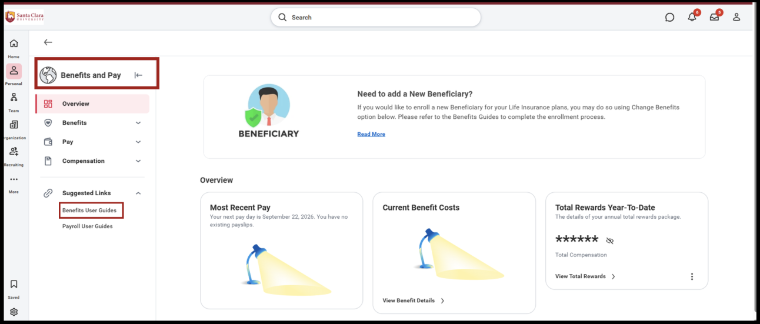
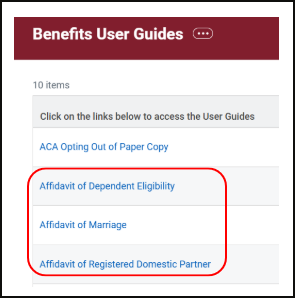
You’ll need to have social security numbers available. To review and/or add dependents in Workday:
- Choose the “Benefits and Pay” app
- Under “Benefits,” choose “Dependents”
- Review the dependents already added, if any.
- Choose the “Add” button to add dependents.
- Under “Reason,” choose “Add Dependent > Other/Open Enrollment” and complete the required fields
- Under “Attachments,” upload the applicable affidavit. For “Category,” select “Benefits”
- Submit
- After you’ve added them as Dependents, you can elect coverage for them in various plans (e.g., medical).
What is the age limit for covering a dependent child?
Dependent children will be covered until the end of the month in which they turn 26. If they have a mental or physical disability that existed prior to age 26 and they are incapable of self-support, they may remain covered past the age of 26. Additional documentation will be required if not already on file; please contact the Benefits Department for more information.
Medical Plans FAQs
What are some of the differences between the Aetna plans?
You may view plan summaries on the Open Enrollment site under “Step 2: Review 2027 Plan Information.” There is also a medical comparison chart. Here are some features of each plan:
Aetna EPO: You may only receive services from providers that are in-network. Designating a primary care physician (PCP) is encouraged but not required. The Aetna EPO does not require a referral to see a specialist.
Aetna EPO 2000 Deductible Plan: Like the Aetna EPO, you may only receive services from providers that are in-network, designating a primary care physician (PCP) is encouraged but not required, and a referral is not required by Aetna in order to see a specialist. However, for certain services, you must pay a $2000 individual/$4000 family deductible before the insurance pays. After the deductible is met, you pay 10% of the cost of those services (this is called coinsurance). Examples of services for which the deductible and coinsurance apply include inpatient and outpatient hospital services (including maternity) and outpatient surgery. For other covered services, you will have a copay, unless the plan covers 100%. Please carefully review the plan summary for more information about covered services and whether they are subject to the deductible/coinsurance or co-pays.
Aetna Choice PPO HDHP: The Aetna Choice PPO HDHP plan (which you may also see referred to as Aetna Choice POS II Open Access HDHP) offers considerable flexibility, as it does not require a referral for a specialist and you may also go out-of-network. The tradeoff to having this flexibility is that you’ll likely have higher out of pocket costs, because 1) this plan has the highest premiums of any of the SCU offerings, 2) you’ll need to meet a high deductible before the insurance starts paying, and 3) after you meet the deductible, you typically pay a co-insurance amount. If you go out of network, the cost is even higher, and you may also be subject to balance billing (see next question).
I want to see healthcare providers that do not contract with any insurance plans, or if they do, not any that SCU offers. What are my options?
The only SCU medical plan that includes out-of-network coverage is the Aetna Choice HDHP PPO. This may be a good option for you if you want to see an out-of-network provider, but it’s important that you understand how insurance works in these situations as you’ll be subject to balance billing. Because Aetna does not have a contract with an out-of-network provider there is no negotiated rate, but there is an “allowed amount” for each service, and Aetna will base payment on this allowance. The allowance is typically based on 105% of what Medicare would pay for the same service. This is perhaps best illustrated by the following example:
- You visit an out-of-network provider who charges $250 for the visit.
- Let’s assume the Aetna allowed amount for the service provided at that visit is $200.
- If you have not yet met the out-of-network deductible, you will be responsible for paying $250, and $200 will be applied to the deductible.
- If you have met the out-of-network deductible, Aetna will apply the out of network percentage (typically 70%) to the allowed amount. In our example, Aetna will pay $140 (70% of $200), and you will be responsible for the balance of $110.
How do I find out if my doctor (or other healthcare provider) is in-network with Aetna?
Visit the Aetna site: https://www.aetna.com/individuals-families/find-a-doctor.html
- Under “Don’t have a member account,” choose “Plan through employer.”
- Enter your preferred location, and select “Medical” under “What type of plan do you need?” Click “Continue as a Guest”
- Look or search for the plan you’re interested in:
- PPO HDHP: Under “Aetna Open Access Plans,” choose “Aetna Choice® POS II (Open Access).”
- EPO and EPO 2000 Deductible: Under “Aetna Open Access Plans,” choose “Aetna Select℠ (Open Access).”
- Select “Continue.”
- Search by your provider’s name or choose a category to browse available in-network providers in your area.
You may also contact your provider’s office directly to inquire whether they are in-network for the plan you’re interested in. Use the exact plan name listed above (Aetna Choice POS II for the HDHP/PPO and Aetna Select Open Access for the EPOs). Please note that healthcare providers, medical groups, and hospitals contract with Aetna and if the contract ends without a new agreement, they would no longer be in-network. Unfortunately, this can happen at any point during the year (based on the terms of the contract) and is typically not considered a qualifying event for which a plan change could be allowed.
I have seen the Aetna High Deductible Health Plan (HDHP) referred to as both a Preferred Provider Organization (PPO) and a Point of Service plan (POS). Which type of plan is it?
The Aetna HDHP operates as a “true” PPO plan. Aetna’s official name for this plan is Aetna Choice POS II (Qualified High Deductible Plan).
How does the Kaiser plan work?
With the Kaiser HMO, you will pick a primary doctor to coordinate your care, including making referrals as needed. Your doctor, specialists, pharmacy, and labs are all connected as part of the Kaiser healthcare system, and are often located within the same facility. All services must be provided within the Kaiser network (except in case of emergency). Enrollees must live or work in a Kaiser service area within Northern or Southern California.
Dental & Vision Plan FAQs
Is the Guardian dental plan a PPO?
Yes, it is a dental PPO plan. As such, you may go to any dental provider, but you may have less out-of-pocket costs if you receive services from an in-network provider.
How do I find out if my dentist is in-network with Guardian?
Visit Guardian: guardiananytime.com/fpapp/search. Select DentalGuard Preferred as the plan type. You may also ask your dental provider if they are in-network with the Guardian PPO.
Do I need to enroll in Anthem Blue View Vision if I am in the Kaiser Plan?
As a Kaiser member, vision is covered through the Kaiser plan. However, you may also enroll in Anthem Blue View Vision for additional coverage. Please be mindful that the two plans are out of network with each other.
Do I need to enroll in Anthem Blue View Vision if I plan to enroll in an Aetna medical plan?
The Aetna PPO HDHP plan covers only a routine eye exam every 24 months. The EPO plans do not include any vision coverage. If you would like vision coverage, including coverage for lenses/glasses, you should consider enrolling in the Anthem Blue View Vision plan.
Flexible Spending Accounts FAQs
I enrolled in the Healthcare FSA (or Limited Purpose FSA) in 2026 but I won’t use all my funds before December 31, 2026. Will they roll over to 2027?
The maximum amount that can be rolled over to 2027 is $680. If you do have funds rolling over to 2027, please take that into consideration when calculating how much you wish to elect for 2027.
I will incur childcare expenses for my child who will turn age 13 in 2027. Am I able to enroll in the Dependent Care FSA?
You may enroll for 2027; however, childcare expenses are not eligible for reimbursement once your child turns age 13.
I enrolled in the Dependent Care FSA in 2026 but I won’t use all my funds by December 31, 2026. Will they roll over to 2027?
No, dependent care FSA funds are truly “use it or lose it” and will not roll over to the new year.
I enrolled in the Healthcare Care FSA (or Limited Purpose FSA) and/or the Dependent Care FSA in 2026. Will I need to re-enroll if I want to participate in 2027?
Yes, per regulations you are required to make a new election each year, even if it’s the same amount.
I enrolled in the Mass Transit/Commuter FSA in 2026. Will I need to re-enroll if I want to participate in 2027?
No, unlike the other FSA plans, Mass Transit elections can be made as often as monthly. Elections must be made in Workday between the 1st and 10th of the month. Unless you make changes, the election in effect in December will also be in effect in January. You do not need to wait for Open Enrollment every year to make changes.
Health Savings Accounts FAQs
If I’m enrolled in the HDHP/PPO plan in 2026 but switch to a different medical plan during Open Enrollment, what happens to my HSA?
You may no longer contribute to an HSA beginning 1/1/27, but you can still use your HSA funds to pay for qualified healthcare expenses. If you leave your funds at Health Equity, any monthly maintenance fees that SCU has been covering will start being drawn from your account. Please contact Health Equity (877.857.6810) if you have additional questions.
Retirement Plan FAQs
Can I enroll in the 403(b) or change my election during Open Enrollment?
Once you are eligible to participate in the University’s 403(b) plan, you can enroll or make changes at any time. You aren’t limited to the Open Enrollment period! Please visit the SCU Retirement page for more information about our retirement plans, including links to our retirement portal and instructions for making changes.
Additional Resources
What if I have additional questions?
There are many resources available if you have questions! Here are some:
- Through Health Advocate, employees and their family members (spouse/DP, dependent children, parents, parents-in-law) can receive confidential support such as help understanding benefits (including Medicare), resolving claims issues, and finding in-network providers. This Health Advocate flyer summarizes their services and includes contact information.
- Individual carriers (e.g., Aetna, Kaiser).
- And of course, your Benefits team! Please email [email protected] with your questions, or to request a 1:1 appointment. Please note that toward the end of Open Enrollment, the appointment slots fill up and the team experiences a higher than usual volume of calls and emails.